Dry eye disease (DED) is one of the most common ocular conditions, affecting tens of millions of people worldwide. It occurs when the eye does not produce enough tears, or when tears evaporate too quickly, leaving the eye surface inadequately lubricated. Oculoplastic surgeons evaluate and treat dry eye, particularly when it relates to eyelid malposition, lagophthalmos, or previous eyelid surgery.
Dry eye is frequently associated with eyelid laxity, incomplete closure, and thyroid eye disease. See our Eyelid Laxity and Lagophthalmos pages for related surgical conditions.
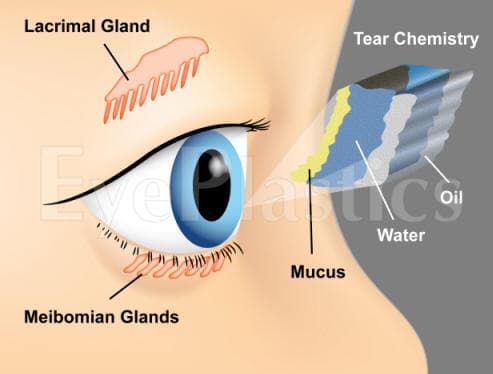
Tear film layers — lipid, aqueous, and mucin components that protect the ocular surface
Tears coat the ocular surface and are composed of three layers:
Lipid layer (outermost) — secreted by the meibomian glands in the eyelid margins. Reduces evaporation and gives the tear film stability.
Aqueous layer (middle) — produced by the lacrimal gland and accessory lacrimal glands. Provides moisture, oxygen, and immune factors.
Mucin layer (innermost) — secreted by goblet cells in the conjunctiva. Anchors the tear film to the corneal surface.
Disruption of any layer can produce dry eye symptoms. The most common form is evaporative dry eye, due to meibomian gland dysfunction (MGD), estimated to account for the majority of cases.
Causes of Dry Eye
Aqueous Deficiency
Sjögren's syndrome
Lacrimal gland disease
Prior lacrimal surgery
Radiation to the orbit
Evaporative
Meibomian gland dysfunction
Blepharitis / rosacea
Incomplete eyelid closure
Ectropion / eyelid laxity
Other Factors
Thyroid eye disease
Contact lens wear
Systemic medications
Environmental exposure
Evaluation
A thorough dry eye evaluation includes:
Symptom questionnaires (OSDI, SANDE) — standardized scoring of symptom severity and frequency.
Slit lamp examination — evaluates lid margin, meibomian gland orifices, conjunctival goblet cells, and corneal staining.
Tear break-up time (TBUT) — measures how quickly the tear film breaks between blinks. Normal ≥10 seconds.
Schirmer's test — quantifies aqueous tear production. A strip of filter paper is placed at the lower lid margin.
Meibography — infrared imaging of meibomian glands to assess dropout and morphology.
Eyelid evaluation — checking for lagophthalmos, ectropion, trichiasis, or incomplete blink contributing to exposure.
Medical Treatment
The stepwise approach to dry eye treatment depends on disease severity:
Artificial Tears & Lubricants
Preservative-free artificial tears are the first-line treatment. Frequency depends on severity — from as-needed to every 1–2 hours. Gel formulations and ointments provide longer contact time, especially useful at night. Patients with evaporative dry eye benefit from lipid-supplementing drops.
Prescription Anti-inflammatory Drops
Restasis® (cyclosporine 0.05%) — reduces inflammation and stimulates goblet cell proliferation. Full effect in 3–6 months.
Xiidra® (lifitegrast 5%) — blocks LFA-1 to reduce T-cell-mediated surface inflammation. May provide faster symptom relief.
Cequa® (cyclosporine 0.09%) — higher concentration cyclosporine with nanomicellar delivery.
Lid Hygiene & Warm Compresses
For meibomian gland dysfunction: warm compresses applied for 5–10 minutes to melt thickened meibum, followed by gentle lid massage. Lid scrubs with commercial lid wipes (now preferred over dilute baby shampoo, which can irritate the ocular surface) reduce bacterial load and improve gland function.
Punctal Occlusion (Punctal Plugs)
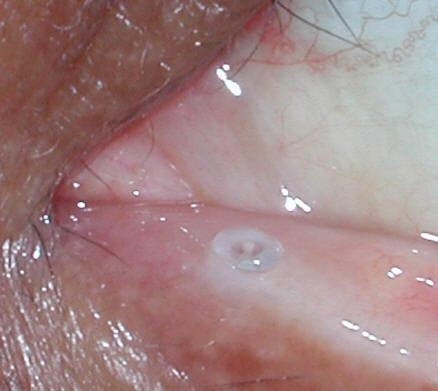
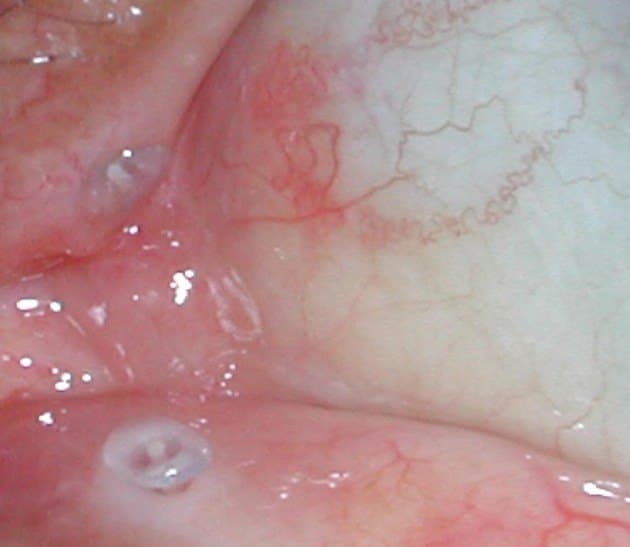
Punctal plug seated in the lower-eyelid punctumPunctal plugs in both the upper and lower puncta
Punctal plugs are small devices inserted into the tear drainage openings (puncta) on the upper and lower eyelids to reduce tear drainage and increase tear film volume on the eye surface. They are a simple office procedure performed under topical anesthesia.
Temporary plugs — made of collagen or other absorbable material; dissolve in days to weeks. Used to test response before permanent occlusion.
Permanent plugs — silicone or acrylic devices; can be removed if needed. Placed in the horizontal canaliculus (intracanalicular) or at the punctal opening (punctal).
Plugs are appropriate when dry eye symptoms persist despite adequate lubrication therapy and anti-inflammatory treatment. They are contraindicated in active ocular surface inflammation or chronic dacryocystitis.
Surgical Treatment
When dry eye is related to eyelid malposition or incomplete closure, surgical correction addresses the root cause:
Ectropion repair — restores the lower lid to its normal apposition against the globe, allowing the tear meniscus to form properly and the punctum to drain effectively.
Gold weight implantation / tarsorrhaphy — for lagophthalmos from facial nerve palsy, reduces nocturnal and incomplete closure exposure.
Orbital decompression — in thyroid eye disease with proptosis, reducing globe protrusion improves lid-globe apposition and exposure.
Punctal cautery — permanent closure of the puncta by thermal cautery when plugs are insufficient or repeatedly expelled.
Thermal Pulsation (LipiFlow) for Meibomian Gland Dysfunction
For evaporative dry eye from meibomian gland dysfunction, in-office thermal pulsation treatments warm and express the blocked glands.
Dry Eye After LASIK / PRK
Refractive surgery commonly reduces corneal sensation and tear production due to severing of corneal nerves during flap creation or ablation; this is usually transient but can be persistent in some patients. Most patients experience significant dry eye in the first 3–6 months after LASIK. PRK patients may also develop dry eye though the mechanism differs slightly. Management includes:
Anti-inflammatory drops (cyclosporine, lifitegrast) if symptoms persist beyond 3 months
Punctal plugs for patients with persistent aqueous deficiency
Evaluation for underlying blepharitis or MGD that may have been unmasked by surgery
Patients with pre-existing dry eye should be counseled before LASIK about the risk of symptom worsening and should consider treatment optimization before undergoing refractive surgery.
Frequently Asked Questions
What causes dry eye disease?
Dry eye disease is caused by insufficient tear production, poor tear quality, or excessive tear evaporation. Common causes include meibomian gland dysfunction (the most common), aging, autoimmune disease (Sjögren's syndrome), eyelid malposition, post-LASIK changes, and certain medications.
When does an oculoplastic surgeon treat dry eye?
Oculoplastic surgeons treat dry eye when the cause is structural — such as eyelid malposition (ectropion, entropion), incomplete eyelid closure (lagophthalmos), or after eyelid or orbital surgery. They also place punctal plugs to reduce tear drainage and manage ocular surface disease in the perioperative setting.
What is the difference between Restasis and Xiidra?
Both are prescription eye drops for dry eye disease, but they work differently. Restasis (cyclosporine) suppresses inflammation that damages tear-producing cells. Xiidra (lifitegrast) blocks a specific inflammatory pathway (LFA-1/ICAM-1 interaction). Both take weeks to months for full effect.
Do punctal plugs help dry eye?
Yes. Punctal plugs are small biocompatible devices inserted into the tear drainage openings (puncta) to reduce drainage and keep natural tears on the eye surface longer. They are a simple office procedure and are often used when eye drops alone are insufficient.
What should I expect during a dry eye consultation with an oculoplastic surgeon?
During your consultation, Dr. Chapman will perform a comprehensive evaluation including tear production testing, tear film analysis, and examination of your eyelid position and closure. They'll review your symptoms, medical history, and previous treatments to determine which management approach—from conservative measures to surgical intervention—is best suited for your specific condition. This thorough assessment ensures your treatment plan addresses the underlying cause of your dry eye rather than just symptoms.
What are the potential risks and complications of dry eye surgery?
Like any surgical procedure, dry eye treatments carry potential risks including infection, bleeding, and temporary discomfort or irritation. Specific complications depend on the procedure; for example, eyelid tightening surgery may temporarily affect lid sensation, while exposure correction surgeries rarely have serious complications but require proper healing. Dr. Chapman will discuss all risks specific to your recommended procedure and explain how they minimize these risks through their surgical expertise and technique.
How long does it take to see improvement after dry eye treatment?
Timeline varies depending on the type of treatment: punctal plugs may provide relief within days, while prescription medications typically show improvement over 4-12 weeks of consistent use. Surgical procedures for exposure or lagophthalmos generally show results within the first few weeks, with continued improvement over 2-3 months as healing completes. Dr. Chapman will provide specific expectations based on your chosen treatment and help you understand the recovery process.